Since I've been remiss in getting pictures on the blog, here is a sampling of how Connor has been spending the last few months in Gamboa.
Tuesday, May 13, 2008
Western Highlands
Since I've been remiss in getting pictures on the blog, here is a sampling of how Connor has been spending the last few months in Gamboa.
Saturday, March 1, 2008
Javier sighting
Fast forward to December 2007, when I went to Coiba National Park with Tina and Carwyn via Santa Catalina. I asked the scuba guys if they knew a gringo named Javier who might have bought land in Santa Catalina 13 years ago, and they did! So once back in Sta. Catalina, I asked around and found Javier's house, right in the center of town - and there was Javier! We were in a major rush to get cleaned up and catch the last bus out that night that might or might not be running so we just had a few minutes to catch up. In short, Javier has been living the good life in Santa Catalina (with some time in Santiago) all these years, including living off the land/sea as a subsistence fisherman for 6 years. He's now married to a lovely local woman named Kenia and they have 2 sweet kids. And he looks pretty much the same! They built a sweet house in the center of town that they rent out and have recently started running ecotours to Coiba - check out the Casa Kenia website. Well, we were lucky and caught the bus - and the bus driver didn't mind stopping outside Javier's house so Tina could document our Javier sighting:
In February our friends Jamie & Summer came to visit. And what they really wanted to do was go to Coiba. What could we say - no?? Especially since John hadn't been, and we only have 4 more months here... So we e-mailed Javier to see if he could set up a trip on short notice. Javier was able to accommodate us. The five of us (Summer, Jamie, John, Kirsten & Connor) spent 3 days/2 nights in Coiba with Javier. It was great - great snorkling, some excellent hikes, a flock of scarlet macaws - and time to catch up with Jav. We'll post pix soon!
Wednesday, February 6, 2008
Research Highlight
My research will show how some forest songbirds use degraded, fragmented forest habitats. In
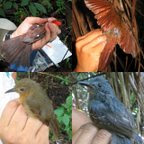
I am capturing, radiotagging and releasing individual birds from three focal species: the dusky antbird, red-throated ant tanager, and cocoa woodcreeper. The three species are different sizes and from different bird families, and are all relatively common in the forests of central

tanager, woodcreeper, and male and female antbirds (clockwise)
Once a bird is radiotagged, we track the bird’s movements and record behavior and habitat types during 1-hour observation periods. Using GIS software to compile land cover and land use data, we compare relocations of each individual bird with the habitat and surrounding landscape. The resulting data will be analyzed to determine if each species has particular habitat preferences, if their behavior or movement rates are different in different habitats or edge types, and how large a gap or forest opening the birds will cross.
Working with Isis Ochoa to tag a bird
During field work in 2007, we radiotagged and tracked 39 individuals in three sites. Preliminary analyses indicate that dusky antbirds and red-throated ant tanagers are largely confined to forest habitat, that is, they do not use the more-open habitat surrounding forests. Cocoa woodcreepers spend most of their time in forest habitat but will also forage on individual trees growing in park-like surroundings and back yards. Both woodcreepers and ant tanagers were observed crossing gaps of up to 30 m to move from one forest patch to another. All three species were observed foraging in and moving through edges of forests, and are able to use edgy, patchy habitat as long as there is sufficient forest.
Work planned for 2008 will include surveys of forest patches that are different sizes and that are different distances from other forests. I will use the results from the radiotracking study and studies by other STRI researchers to make predictions of the minimum size of a forest patch necessary for several songbird species. I will then test these predictions with the new survey data. Together with the complete results from the radiotracking study, this research will provide conservation planners with critical information about the species expected to persist in highly fragmented, human-dominated landscapes, and what types of land uses are compatible with providing habitat to birds.
I am being supported for 15 months in 2007-2008 at the Smithsonian Tropical Research Institute
Teaching Panamanian biologists about radiotelemetry
Wednesday, January 23, 2008
Birthday and Christmas Pictures
Lots more pictures in the album.
Monday, January 7, 2008
Christmas in Panama
We also enjoyed traveling with Derek, Ilse and Jim in the week before Christmas. In the meantime here is our Christmas card picture
Kirsten and Connor had a good time on Coiba, and I managed for 3 days even without our daily phone call. Some non-diving pics (from Tina of course).
And finally, another album from our Gamboa Thanskgiving, with some nice shots of Kirsten playing flag football (I was the photographer for that portion of the day, you might notice we are less well-represented afterwards).
Saturday, December 15, 2007
El Valle
G-rated bath shot - the tub was about 5 feet diameter and Connor had a great time crawling around.
Connor has 8 teeth to brush - as long as I do mine first he seems to enjoy it. I'm in charge of the bedtime routine, which goes, bath (loves it!), put on new diaper and sleeper (not a big fan), nurse, brush teeth, read 2-3 stories (usually loves it), say goodnight to mommy, turn out lights and sing songs (variable), go to sleep. From bath to sleep is about an hour.
We decided the suspension bridge was enough excitement and passed on the zipline canopy adventure. At $50 it is a little too expensive for me anyway. We have definitely noticed increased hotel prices, at least for tourist-oriented places. There are also many new beach developments and gringo retirement developments all over the country - including one called Altos del Maria near my PC site. The 'Bejuco-Sora' road mentioned on the web site is the one I took to get to my town. These properties go for $200K and up. Some of my friends in Bajo del Rio got construction jobs there so I have mixed feelings about the whole phenomenon.
In El Valle we met a couple that we looking for retirement property. They had a typical story - retired on a military pension, worried that their property taxes will go higher than they can afford. Of course they also complained about Mexican immigrants (they live near El Paso) which seemed a bit hypocritical, since they were considering becoming immigrants themselves...
Thursday, December 13, 2007
Bon Voyage!
Random Thought: don't drive like this guy:
Tuesday, August 21, 2007
Isla Cañas
View Larger Map
Arrival is by boat, going through the mangroves, so we got Connor decked out in a new (thanks Jim & Ilse!) infant vest – we tried it out in the resort pool beforehand, and it actually does a good job of keeping his face out of the water. And no, testing it did NOT include tossing him into the deep end.
Due to Kirsten’s service on the island we were ‘honored guests’ and were allowed to stay in the ANAM cabin, which has indoor plumbing and an air-conditioned bedroom (!). Quite a step up from Kirsten’s lodging as a PCV.
There’s a volunteer on the island now – they’ve had a couple come and leave, but Stacey seems to love the island as much as it deserves, and the people speak highly of her. She gets quite an earful of stories about their beloved ‘Kiri’ but seems to handle it well.
We took along Karina, who was just a little girl when Kirsten lived there but now has her own baby, Dario. Karina grew up on the island but lives in another town with her dad and stepmom now. Her mom died a few years ago when a hantavirus plague spread through that part of the country.
Karina holding Connor
So basically we did lots of visiting and made a couple trips to the beach. Connor got lots of attention, and we had lots of people willing to hold the babies. Unfortunately the island is about a 7-hour drive (not including pit stops) so we haven’t been back yet. But it will definitely be a possible destination with visitors!
Connor's friends on the island
Thursday, July 19, 2007
Santa Clara
Here's the beach we went to a few weeks ago at Santa Clara. As I mentioned we stayed at a place called Las Sirenas for a night and spent the day at the beach. Although in this shot the beach looks fairly undeveloped, in the other direction there are lots of beach houses - some more like mansions - that wealthy Panamanians use on the weekends and/or during verano.
We've been trying to keep Connor from getting sunburned which means sitting in the shade. He didn't seem to mind too much. It does mean taking turns going into the water for the most part.
We introduced Connor to the Pacific Ocean - he wasn't too sure about it at first but seemed to have a good time.
We had some ceviche in a nearby restaurant and met three current Peace Corps volunteers - two were leaving within a few weeks, one coincidentally going back home to Seattle. Just to show how time flies (and/or how long I was in grad school), she started college while I was a graduate student, graduated, worked for a year, and did half her Peace Corps service, all before I finished.It was fun to hear a little bit about their experiences. We invited the volunteer that's still in-country to stay with us in Gamboa if she has to come in to the Peace Corps office. When we were volunteers we had several people with whom we could stay, so it would be nice to fulfill the same function now that we have the extra bedroom.
Friday, July 13, 2007
Hello again
Here's a picture just to keep everyone interested - hope everyone's having a good summer (if you're in the temperate zone).
-John
Wednesday, June 6, 2007
Driving Lessons
I'm in the process of getting it insured, and on Tuesday took a new route away from the Smithsonian to try to get our rent paid at a bank nearby. I turned onto an empty street and ran into the very beginning of a student protest.
LESSON NUMBER ONE: it's probably best to just stop and turn around if you see a group of 20+ muchachos covering their faces with rags and holding rocks.

Anyway, I got close enough for them to surround the car, sit on the hood, and open the doors. LESSON NUMBER TWO: if you have forgotten LESSON NUMBER ONE (see above), you could try to lock your doors. At that point I looked around and realized my wallet and cell phone were sitting on the passenger seat, so I stuffed them between my legs and put the car in reverse. All I remember were the boys saying ¿Qué pasó, qué pasó? (what's up?). Then one of them on the driver's side started saying 'cierre la puerta, cierre la puerta' (close the door), perhaps realizing that I had no idea what the heck was going on. I also speculate that they hadn't gotten rev'd up yet (it was about 3:00 p.m.) or it might have looked like this:
But they didn't throw rocks, or taking anything from the car (my backpack was sitting in the back seat), so I will just count my blessings and consider them lessons learned.
Tuesday, May 29, 2007
how Panama has changed, part 2...

Bill Laurance (with disc). La Prensa.
Here's an article (in Spanish) about people playing ultimate frisbee - and the photo they published with it happened to feature Bill Laurance, my advisor at STRI. We played with this group at Clayton for the first time on Sunday 5/27. Kirsten and I take turns playing and staying on the sidelines with Connor. It's a great game.
Monday, May 28, 2007
Life in Gamboa
I'm usually home by 5:30 and we often take Connor out for a walk together, or Kirsten goes for a run while I stay with the bebe. There are many other STRI-affiliated families here with kids - for now Connor is the youngest, but there are a few babies under 1, a few toddlers, and several other children under 10. The house in the background is fairly typical for Gamboa.
Part of Gamboa is known as 'Santa Cruz' - it's the area closer to the canal where the "silver workers" (meaning working class) lived in smaller houses, as opposed to the "gold workers" who lived up on the ridge in larger houses (with a nice breeze). This historical segregation is reflected by more Panamanians living today in Santa Cruz, compared to more gringos and middle-class Panamanians living in the larger houses in Gamboa.
Santa Cruz has the town's main tienda and two fondas (small restaurants).
We had a comida del dia here with a can of Coke for $2.60 each.
Connor's doing well and seems to enjoy life most of the time - here's a parting happy baby shot:
Monday, May 7, 2007
Tuesday, May 1, 2007
Connor's Turn

My mom took some pictures so you can see my new home:
my bassinet (thanks Dee!) next to mom & dad's bed
bath time in the kitchen sinkOur biggest outing so far was going to Bajo del Rio, the town my dad lived in for two years. I was hungry when we got out of the car but everyone wanted to see me and touch me and hold me - it was a little scary but I let them know about it so they gave me back to mommy. Later we visited the maestra that my dad worked with and they said she was my 'abuela Dilsa'. She knew how to hold me.

I heard my mom & dad talking about visiting another place, Isla de Cañas, that's a long car drive and a boat ride away. I think we're going to wait to go there until it's not quite as hot.
I rolled over for the first time when my grandpa Mike was taking care of me here - I did it again this week a couple of times. I also like looking out of the window at the trees and bugs and birds. My dad calls it 'baby TV'. Hope to see you down here sometime so you can hold me and make me laugh!
Monday, April 23, 2007
Work at STRI
My host instution is the Smithsonian Tropical Research Institute. STRI (rhymes with 'high') scientists have been working in Panama and other tropical countries for over 80 years, with offices in Panama City and labs and field stations up and down the Canal.
Just so you know I'm not making this all up - their newsletter of a couple weeks ago noted my arrival :) In a little more detail, I'm going to study how certain species of tropical forest songbirds use the non-forested habitats (for example tree plantations, human settlements, pasture) that are located adjacent to forested areas. I'm trying to select my specific study sites this week and next, and should have some pictures of the birds soon.
We live in a STRI apartment in Gamboa, a town that is just about as far up the canal as you can drive on public roads. My field work will be between Gamboa and Panama City. We can stay in this place only until the end of May, so we're looking for another house or apartment (with an extra bedroom for visitors), in Gamboa or possibly closer to Panama City.
Tuesday, April 17, 2007
Opening blog
J:Welcome to our Panama blog - a way for us to update family and friends with our goings-on. And yes, of course we will post pictures of Connor. Here's one of our first days in Panama, relaxing poolside at the Gamboa rainforest resort where my dad and brother Cameron were staying.
So far we're all doing ok with the heat. Our apartment is fairly nice and we're getting things moved in. We did take time for a gondola ride through the rainforest canopy, and the guides found Connor more interesting than the native fauna!